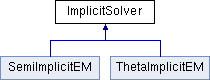
#include <ImplicitSolver.H>
|
| | ImplicitSolver ()=default |
| |
| virtual | ~ImplicitSolver ()=default |
| |
| | ImplicitSolver (const ImplicitSolver &)=delete |
| |
| ImplicitSolver & | operator= (const ImplicitSolver &)=delete |
| |
| | ImplicitSolver (ImplicitSolver &&)=delete |
| |
| ImplicitSolver & | operator= (ImplicitSolver &&)=delete |
| |
| virtual void | Define (WarpX *a_WarpX)=0 |
| | Read user-provided parameters that control the implicit solver. Allocate internal arrays for intermediate field values needed by the solver. More...
|
| |
| bool | IsDefined () const |
| |
| virtual void | PrintParameters () const =0 |
| |
| void | GetParticleSolverParams (int &a_max_particle_iter, amrex::ParticleReal &a_particle_tol) const |
| |
| virtual void | OneStep (amrex::Real a_time, amrex::Real a_dt, int a_step)=0 |
| | Advance fields and particles by one time step using the specified implicit algorithm. More...
|
| |
| virtual void | ComputeRHS (WarpXSolverVec &a_RHS, const WarpXSolverVec &a_E, amrex::Real a_time, amrex::Real a_dt, int a_nl_iter, bool a_from_jacobian)=0 |
| | Computes the RHS of the equation corresponding to the specified implicit algorithm. The discrete equations corresponding to numerical integration of ODEs are often written in the form U = b + RHS(U), where U is the variable to be solved for (e.g., the solution at the next time step), b is a constant (i.e., the solution from the previous time step), and RHS(U) is the right-hand-side of the equation. Iterative solvers, such as Picard and Newton, and higher-order Runge-Kutta methods, need to compute RHS(U) multiple times for different values of U. Thus, a routine that returns this value is needed. e.g., Ebar - E^n = cvac^2*0.5*dt*(curl(Bbar) - mu0*Jbar(Ebar,Bbar)) Here, U = Ebar, b = E^n, and the expression on the right is RHS(U). More...
|
| |
◆ ImplicitSolver() [1/3]
| ImplicitSolver::ImplicitSolver |
( |
| ) |
|
|
default |
◆ ~ImplicitSolver()
| virtual ImplicitSolver::~ImplicitSolver |
( |
| ) |
|
|
virtualdefault |
◆ ImplicitSolver() [2/3]
◆ ImplicitSolver() [3/3]
◆ ComputeRHS()
| virtual void ImplicitSolver::ComputeRHS |
( |
WarpXSolverVec & |
a_RHS, |
|
|
const WarpXSolverVec & |
a_E, |
|
|
amrex::Real |
a_time, |
|
|
amrex::Real |
a_dt, |
|
|
int |
a_nl_iter, |
|
|
bool |
a_from_jacobian |
|
) |
| |
|
pure virtual |
Computes the RHS of the equation corresponding to the specified implicit algorithm. The discrete equations corresponding to numerical integration of ODEs are often written in the form U = b + RHS(U), where U is the variable to be solved for (e.g., the solution at the next time step), b is a constant (i.e., the solution from the previous time step), and RHS(U) is the right-hand-side of the equation. Iterative solvers, such as Picard and Newton, and higher-order Runge-Kutta methods, need to compute RHS(U) multiple times for different values of U. Thus, a routine that returns this value is needed. e.g., Ebar - E^n = cvac^2*0.5*dt*(curl(Bbar) - mu0*Jbar(Ebar,Bbar)) Here, U = Ebar, b = E^n, and the expression on the right is RHS(U).
Implemented in ThetaImplicitEM, and SemiImplicitEM.
◆ Define()
| virtual void ImplicitSolver::Define |
( |
WarpX * |
a_WarpX | ) |
|
|
pure virtual |
Read user-provided parameters that control the implicit solver. Allocate internal arrays for intermediate field values needed by the solver.
Implemented in ThetaImplicitEM, and SemiImplicitEM.
◆ GetParticleSolverParams()
| void ImplicitSolver::GetParticleSolverParams |
( |
int & |
a_max_particle_iter, |
|
|
amrex::ParticleReal & |
a_particle_tol |
|
) |
| const |
|
inline |
◆ IsDefined()
| bool ImplicitSolver::IsDefined |
( |
| ) |
const |
|
inline |
◆ OneStep()
| virtual void ImplicitSolver::OneStep |
( |
amrex::Real |
a_time, |
|
|
amrex::Real |
a_dt, |
|
|
int |
a_step |
|
) |
| |
|
pure virtual |
◆ operator=() [1/2]
◆ operator=() [2/2]
◆ parseNonlinearSolverParams()
parse nonlinear solver parameters (if one is used)
◆ PrintParameters()
| virtual void ImplicitSolver::PrintParameters |
( |
| ) |
const |
|
pure virtual |
◆ m_is_defined
| bool ImplicitSolver::m_is_defined = false |
|
protected |
◆ m_max_particle_iterations
| int ImplicitSolver::m_max_particle_iterations = 21 |
|
protected |
maximum iterations for the iterative method used to obtain a self-consistent update of the particle positions and velocities for given E and B on the grid
◆ m_nlsolver
◆ m_nlsolver_type
Nonlinear solver type and object.
◆ m_particle_tolerance
| amrex::ParticleReal ImplicitSolver::m_particle_tolerance = 1.0e-10 |
|
protected |
tolerance used by the iterative method used to obtain a self-consistent update of the particle positions and velocities for given E and B on the grid
◆ m_WarpX
| WarpX* ImplicitSolver::m_WarpX |
|
protected |
Pointer back to main WarpX class.
The documentation for this class was generated from the following file:
- /home/docs/checkouts/readthedocs.org/user_builds/warpx/checkouts/24.08/Source/FieldSolver/ImplicitSolvers/ImplicitSolver.H